1.Teaching objectives (knowledge preparation)
Get to know motors, understand the types and performance of motors.
Control the motor through programming.
Being able to combine real-life application scenarios and apply project devices to achieve intelligent application scenarios in daily life.
2.Teaching tasks
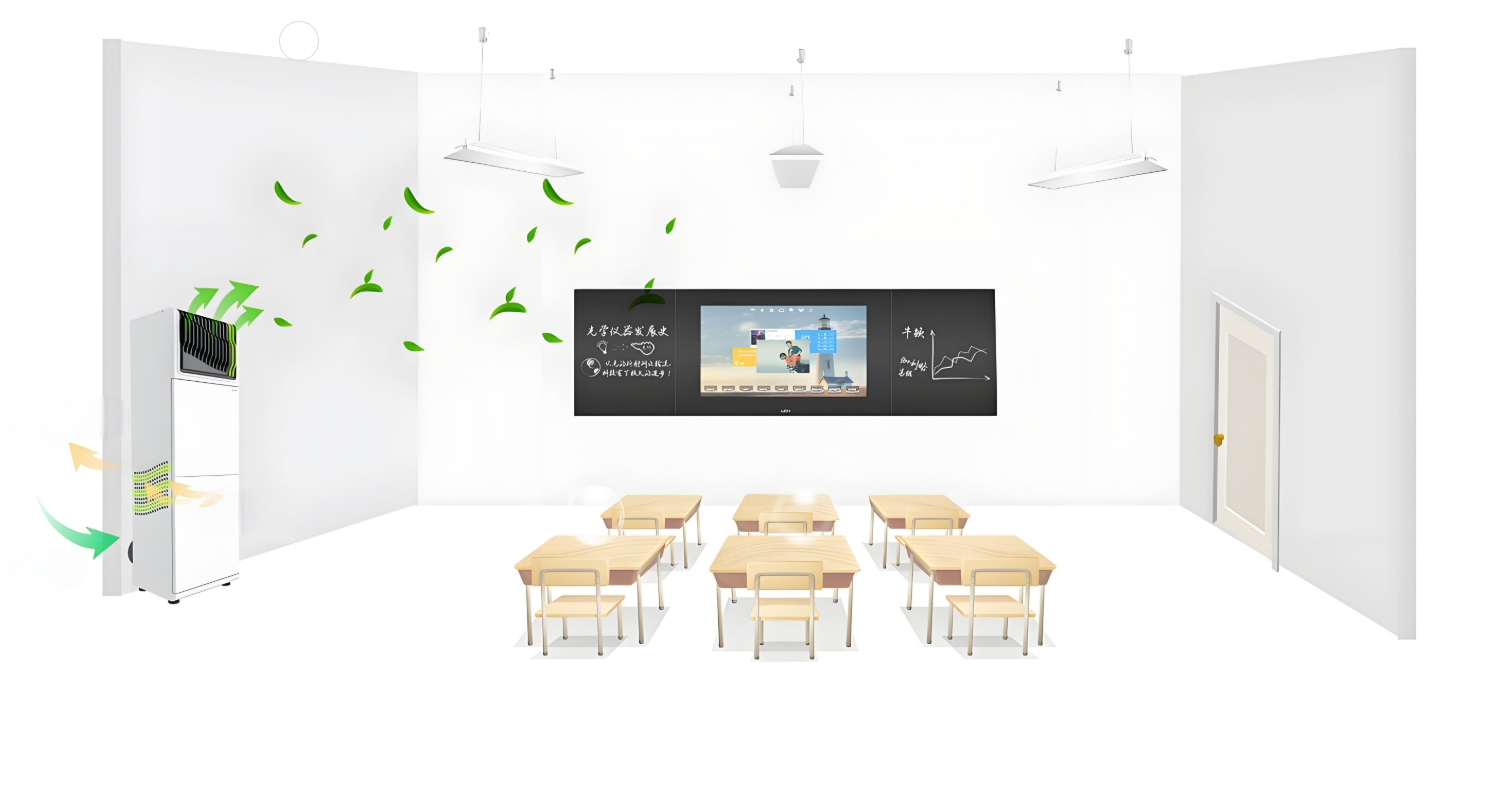
Build a gas exchange device that can achieve internal and external gas exchange in the classroom, and control it through programming.
3.Preparation of teaching environment and equipment
Equipment List: Image (with label number 123456)
Equipment Serial Number Table
| Serial number | number | equipment | Specifications | quantity |
| 1 | Switch | 1 | ||
| 2 | Motor | 1 | ||
| 3 | fan | 1 |
Software: Smart Code programming software.
Hardware: SMART Code kit: Switch, Motor and fan.
Other: Several building block devices.
Detailed List of Structural Components
| Serial number | number | equipment | Specifications | quantity |
| 1 | 3-hole beam | 18 | ||
| 2 | 7-hole beam | 6 | ||
| 3 | 13-hole beam | 6 | ||
| 4 | T-shaped beam | 6 | ||
| 5 | Black sales | 54 |
Note: Materials required to fix a set of sensors: 6 3-hole beams, 2 7-hole beams, 2 13 hole beams, 2 T-shaped beams, and 18 black pins.
4.Project Practice Process
(Summary of Knowledge Points: 1. Components. 2. Program Modules. 3. Program Design)
1.Project video (in video format)
2.Project Steps
Build a classroom space and fix the switch sensor and motor with fan installed on it.
Use SMART Code to program and control devices.
Firstly, create the main program entrance. The example code is as follows:
Then, complete the switch sensor logic. When the switch is pressed and not pressed, there are two states. The example code is as follows:
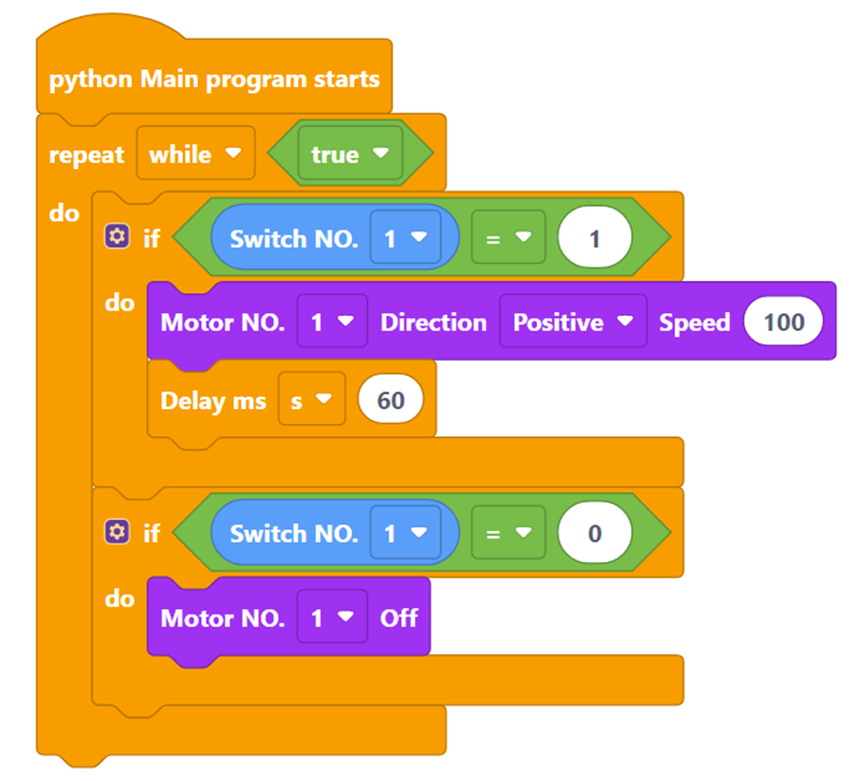
Then, when the switch is turned on, programming is implemented to rotate the motor and switch the sensor. Every time the sensor is pressed, the motor rotates for 1 minute. The example code is as follows:
Finally, complete the programming of the ventilator. The example code is as follows:
Optimization and improvement plan.
Interesting thinking: Can the switch be kept normally open to achieve intelligent control based on environmental changes.
3.Reflection and discussion: What are the influencing factors of school environmental monitoring?
Experimental results
Data records: Table 1 and Table 2
Experimental conclusion: occlusion, ambient temperature, soundproof environment, etc.
5.Extension and Expansion
Reflection and exploration:
Question 1:
Question 2: